

Sunday, January 28, 2007

Saturday, January 20, 2007
Embroidered braids to hide seams


Embroidered braids were used to cover the seams of 14 th century embroidered purses. Frieda Sorber explains this technique in this book:
Ceulemans, C. (1988), Tongeren. Basiliek O.L. Vrouwe Geboorte. I. Textiel van de vroege middeleeuwen tot het Concilie van Trente, Leuven: Peeters
Isis wrote a comprehensive "how to instruction", including pictures: click here.
Sunday, January 14, 2007
tassels: 13th century - mid 14th century

These tassels were made for a member of The Liebaart. I used:
- Aurora fine 2 ply spun silk in blue and red
- yellow embroidery: Devere Yarn, 1200 dernier filament silk
- linen core
- size: ca 2, 5 * 6 cm
- Hoving, T., Husband, T., Hayward, J. (1975), The secular spirit: Life and art at the end of the Middle Ages: New York: The Metropolitan Museum of Art v
- Schneider, J. (1975), Textilien. Catalog der Sammlung des Schweizerischen Landesmuseums Zürich, Zürich: Verlag Berichthaus
- Wilckens von, L. (1991), Die textilen Künste. Von der Spätantike bis um 1500, München, Verlag CH Beck
Monday, January 1, 2007
14th century embroidery patterns
These patterns were used for decorating 14th century purses and wall hangings. You can find pictures of purses embroidered with this type of patterns, from The Netherlands, Germany and Switzerland, in these books:
There are pictures of German wall hangings decorated with these patterns in e.g.


- Ceulemans, C. (1988), Tongeren. Basiliek O.L. Vrouwe Geboorte. I. Textiel van de vroege middeleeuwen tot het Concilie van Trente, Leuven: Peete
- Schmedding, B. (1978), Mittelalterliche Textilien in Kirchen und Klöstern der Schweiz, Bern: Abegg-Stiftung
- Staufer, A. (1991), Die mittelalterlichen Textilien von St. Servatius in Maastricht, Bern: Abegg-Stiftung Riggisberg
There are pictures of German wall hangings decorated with these patterns in e.g.
- Schuette, M., Müller-Christensen. S. (1963), Das Stickereiwerk, Tübingen: Wasmuth
- Wilckens von, L. (1991), Die textilen Künste. Von der Spätantike bis um 1500, München, Verlag CH Beck

- white DMC linen floss
- red and green Au ver a soie silk
- 9*15 cm
- original in Victoria & Albert Museum, London
- chart by Wymarc

- red, white, blue and green Au ver a soie silk
- 8*16 cm
- original in Victoria & Albert Museum, Londen
- chart by Wymarc
Saturday, December 30, 2006
Embroidery threads for satin/brick/gobelin stitch
Frequently used stitches in 14th century embroidery are:

- satin stitch/ brick stitch
- for "how to" pictures, see Wymarc's German embroidery tutorial
- examples in this portfolio: purse, pillow
- gobelin stitch
- example in this portfolio: purse

Monday, November 27, 2006
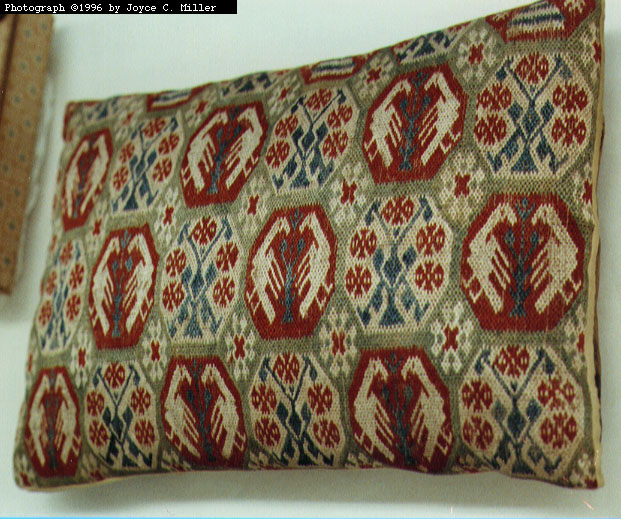
14th century German pillow
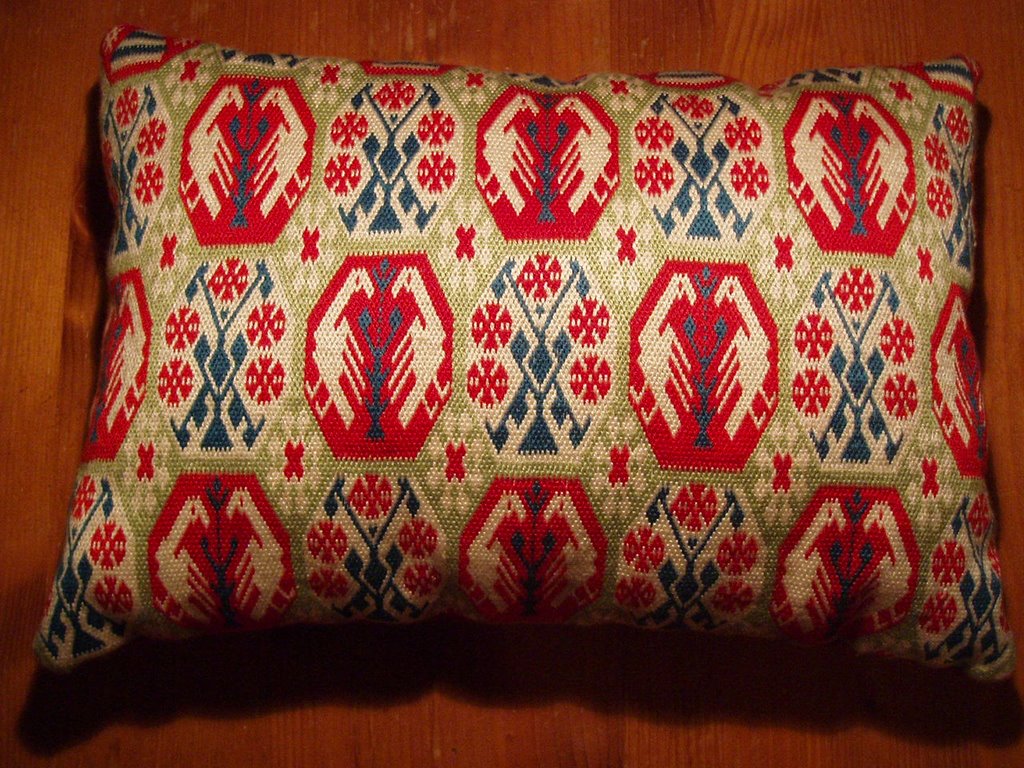
14th century German pillow
- silk embroidery on linen
- embroidery: Au ver a soie spun silk
- brick stitch/ satin stitch
- 35 cm * 24 cm
- original in Kunstgewerbemuseum, Berlin and in Victoria and Albert Museum London
- charts are available by Joyce Miller and Wymarc
A picture and a description of the original can also be found in:
Schuette, M., Muller-Christensen, S. (1963), Das Stickereiwerk, Berlin: Tubingen
Ca 1320 Swiss purse

Front
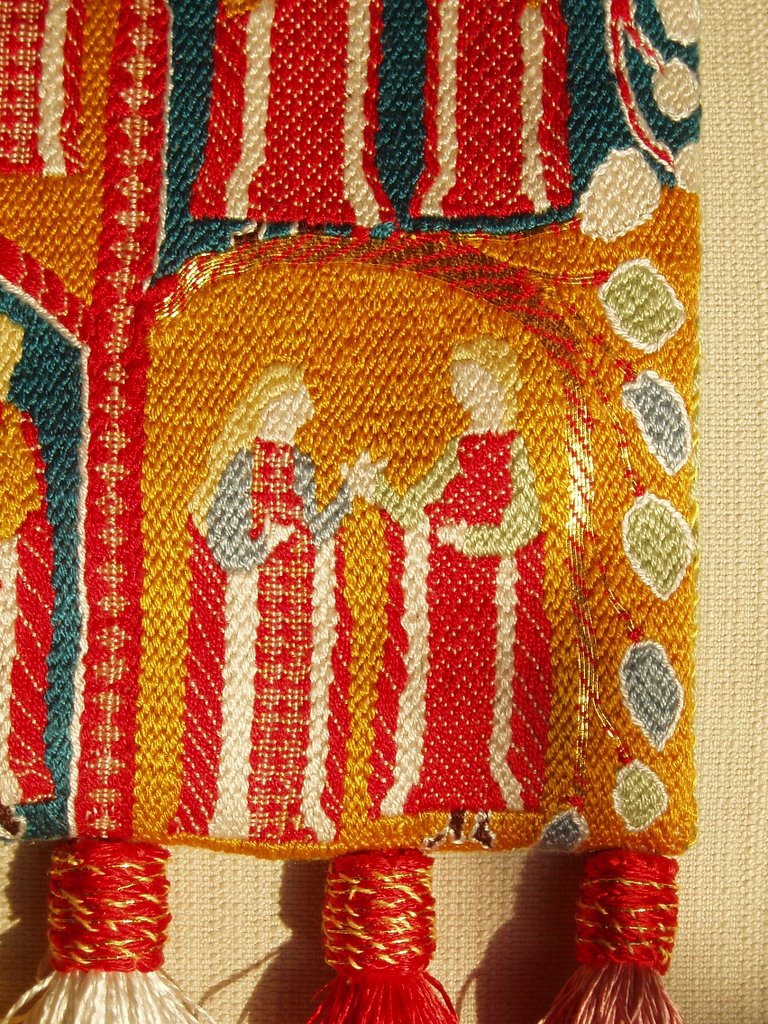
Detail Front
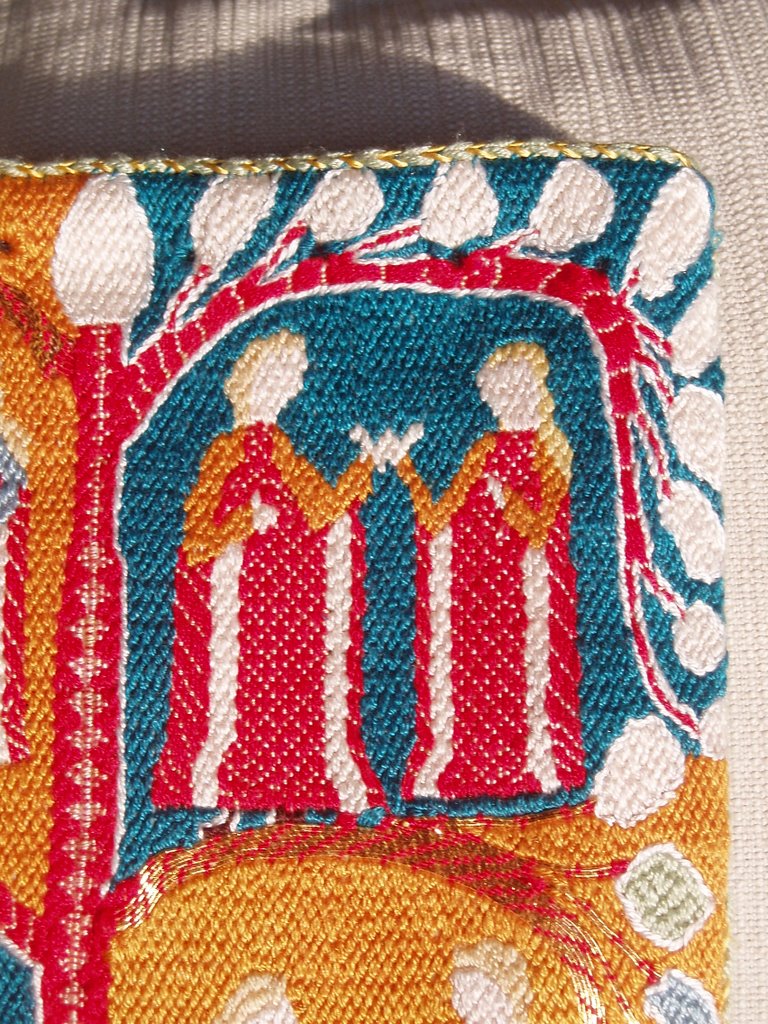
Detail Front
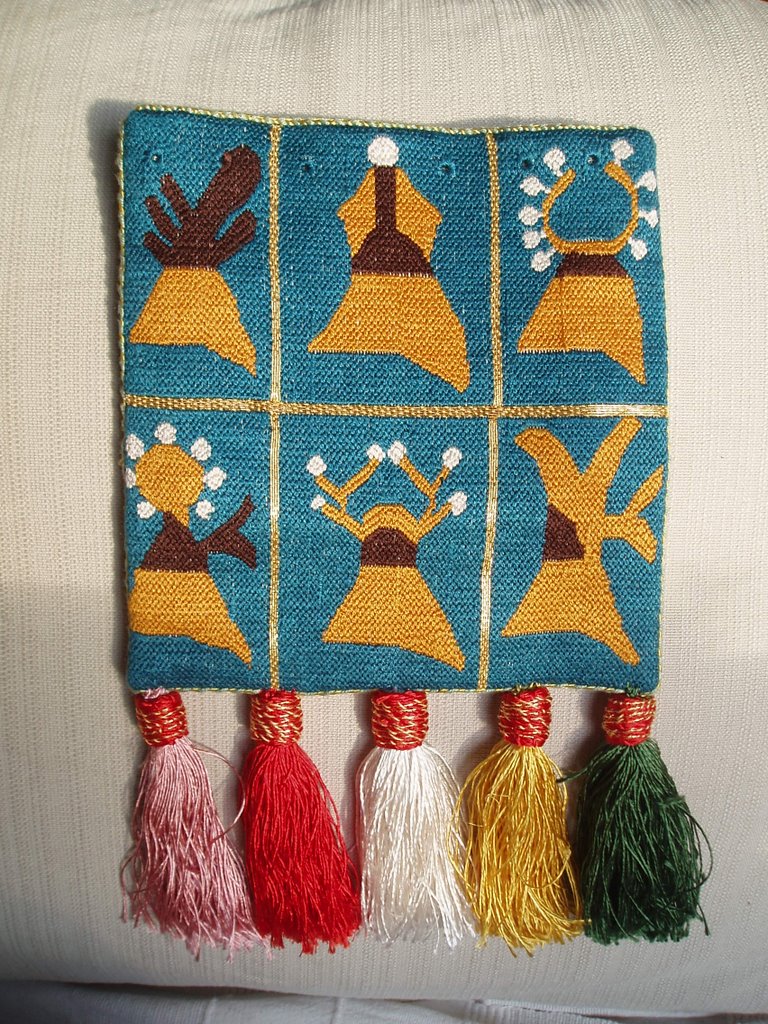
Back
The figures on the back represent heraldic motives, similar to those in the Codex Manesse. For a "who is who" of the heraldic motives on this purse, see Schneider, J. (1975)
Purse:
Schneider, J. (1975), Textilien. Katalog der Sammlung des Sweizerischen Landesmuseums Zurich: Zurich: Verlag Berichthaus
Purse:
- silk embroidery: gobelin stitch and split stitch
- Au ver a soie spun silk
- goldwork: gold thread couched with red silk
- Japanese gold K4. 0.5 mm
- 18 cm * 20 cm
- Devere Yarn 1200 dernier, filament silk, loose twist
- goldwork: gold thread couched with yellow silk
- Japanese gold K4. 0.5 mm
- 12 cm * 2 cm
- original in the Sweizerisches Landesmuseum, Zurich, beutel LM 1825a
Schneider, J. (1975), Textilien. Katalog der Sammlung des Sweizerischen Landesmuseums Zurich: Zurich: Verlag Berichthaus
The Cloisters Museum, New York, owns a smiliar purse. A picture and a description of this purse can be found in:
Hoving, T., Husband, T., Hayward, J. (1975), The secular spirit: life and art at the end of the Middle Ages, New York: The Metropolitan Museum of Art


Subscribe to:
Posts (Atom)